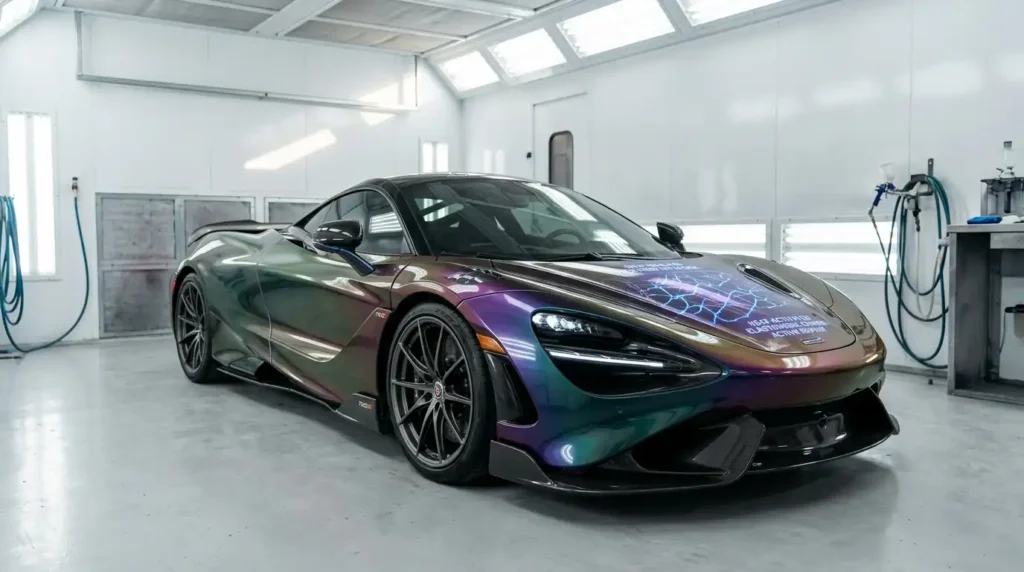
In the world of custom automotive and motorcycle refinishing, achieving a show-stopping finish is only half the battle. Custom builders and painters spend dozens—sometimes hundreds—of hours prepping bodywork, laying down intricate basecoats, spraying chameleon color-shift pearls, and laying delicate real metal leaf. Yet, the moment that vehicle hits the open road, its pristine surface faces constant threats: swirl marks from microfiber towels, road debris, UV degradation, and micro-scratches.
For years, preserving a deep “liquid glass” finish required continuous machine polishing, paint correction, or layering thick Paint Protection Film (PPF). However, the refinishing industry has entered a new era with the rise of Self-Healing Clear Coats and smart elastomeric coatings. By combining shape-memory polymer chemistry with advanced sprayable refinishing techniques, these smart clear coats automatically erase micro-abrasions when exposed to heat, keeping custom paint jobs flawless for years.
The Science of Self-Healing: How Elastomeric Polymers Work
Traditional automotive clear coats—such as standard medium-solids (MS) or high-solids (HS) polyurethanes—cure into a rigid, crystalline structure. When a sharp object or wash mitt scratches a conventional clear coat, it gouges the rigid polymer chains, leaving permanent ridges that reflect light unevenly and create visible swirl marks.
Self-healing clear coats and sprayable elastomeric topcoats operate on a completely different molecular principle. Rather than forming a brittle barrier, they incorporate dynamic cross-linked elastomeric polymers with thermo-responsive shape memory:
- Viscoelastic Flexibility: The clear coat maintains both liquid-like flow properties and solid elasticity at the microscopic level.
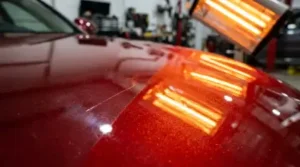
- Thermal Re-Flow Activation: When the coated surface experiences mild thermal energy—such as direct ambient sunlight (120°F–150°F), warm water, or a heat gun—the dynamic polymer bonds temporarily soften.
- Molecular Shape Memory: The polymer chains automatically pull themselves back into their original, perfectly flat orientation, filling in micro-scratches and restoring optical clarity in seconds.
According to Coatings World magazine, advancements in smart polyurethane resins have allowed self-healing clear formulations to match the hardness, chemical resistance, and UV protection of high-end OEM finishes without losing their elastic recovery properties.
Key Benefits for Custom Automotive and Motorcycle Builds
While self-healing technology originally emerged as a factory option on select luxury supercars, its adoption in custom paint booths offers game-changing advantages for custom builders:
1. Protection for Delicate Effects and Metal Leafing
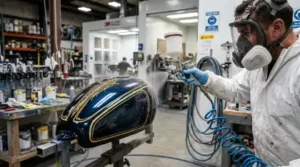
Custom finishes involving multi-dimensional pigments, hyper-shift pearls, or leafed pinstriping cannot be repeatedly buffed or polished. Every time a detailer uses an abrasive polishing compound on a traditional clear coat, a few microns of material are removed. Eventually, this thins the clear coat over delicate leafing edges or alters the refraction of color-shift pigments. Self-healing clears eliminate the need for aggressive mechanical polishing, preserving the integrity of underlying custom layers.
2. Seamless Edge-to-Edge Coverage
While clear bra wraps and PPF provide excellent impact protection, they often leave visible seam lines around custom body lines, recessed vents, and intricate motorcycle gas tanks. A sprayable self-healing clear coat flows smoothly into every curve, rivet, and custom fiberglass contour, providing 100% seamless coverage with zero edge lifting.
3. Extreme Depth and Hydrophobic Performance
Modern elastomeric clear coats are formulated with ultra-high-solids resin structures that offer incredible depth and optical clarity. Additionally, many smart refinishing clears integrate hydrophobic fluoropolymer technology directly into the top layer, causing water to bead aggressively and repelling road grime, tree sap, and bird droppings.
Application Techniques: How to Spray Self-Healing Clear Coats
Spraying a smart self-healing clear coat requires meticulous spray booth discipline, precise measuring, and specialized gun setup. Because elastomeric resins have higher viscosity and unique flow dynamics, custom painters must adjust their standard application techniques.
1. Surface Preparation and Flash Times
Because smart clear coats are optically pure, any dust nibs, tape edges, or improperly flashed basecoat solvents will be locked permanently underneath. Ensure the basecoat, airbrush art, or leafing sizing has fully flashed according to the technical data sheet (TDS) before mixing the clear.
2. Precise Mixing Ratios and Catalyst Matching
Self-healing clears rely on exact chemical stoichiometry to maintain their shape-memory properties.
- Measure by Volume: Always use precise mixing cups or digital scales to measure the clear, hardener, and reducer (typically mixed at 2:1 or 3:1 ratios depending on the brand).
- Temperature-Specific Hardener: Match your hardener speed (slow, medium, or fast) strictly to ambient booth temperature. Using a hardener that is too fast can trap solvent bubbles and impede the self-healing polymer network from properly cross-linking.
3. Spray Gun Setup and Pass Speed
Utilize a dedicated High-Volume, Low-Pressure (HVLP) or High-Efficiency (HE) spray gun fitted with a 1.3mm to 1.4mm fluid tip. Set your inlet pressure between 26 to 29 PSI to achieve atomization without causing dry spray.
Apply the clear coat in two full, wet passes:
- First Coat (Medium-Wet Tack Coat): Spray a smooth, even medium coat to establish adhesion. Allow a 10-to-15-minute flash time until the surface is tacky but does not transfer to a gloved finger.
- Second Coat (Full Flow Coat): Move slightly slower with a 70% pass overlap to lay down a full, glossy coat. This builds the necessary film thickness (typically 2.0 to 2.5 mils dry film thickness) required for the self-healing mechanism to function effectively.
Maintenance and Care for Smart Clear Finishes
To ensure a self-healing clear coat retains its scratch-recovering capability over its 5-to-7-year operational lifespan, vehicle owners must follow proper care protocols:
- Avoid Solvent-Based Waxes: Use only pH-neutral car shampoos and ceramic-safe quick detailers. Harsh solvent-based waxes or aggressive bug removers can break down the top elastomeric layer.
- Allow Solar Healing: For routine swirl marks caused by washing, simply park the vehicle in direct sunlight for 20 to 30 minutes on a warm day. The ambient heat will activate the polymer memory and erase the marks automatically.
- Targeted Thermal Spot Repair: For deeper micro-scratches, a professional detailer can pass a heat gun (set to medium heat, held 6–8 inches away) or pour warm water (140°F) over the affected area to instantly trigger recovery.
Embracing the Future of Custom Paint Protection
As custom automotive finishes become more intricate and visual effects push new artistic boundaries, protection technology must evolve alongside it. Self-healing clear coats bridge the gap between brilliant, show-quality aesthetics and practical, real-world durability. By integrating smart elastomeric refinishing into your custom spray booth workflow, you can offer clients a finish that doesn’t just look incredible on day one—but actively maintains its deep, scratch-free gloss for miles to come.