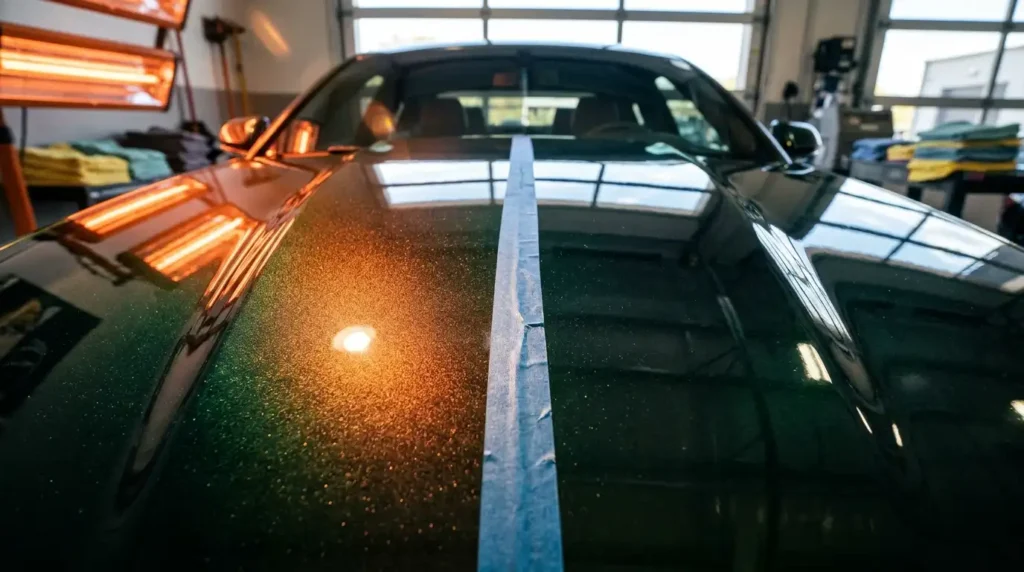
The automotive refinishing industry has evolved far beyond traditional acrylic lacquers and basic two-component (2K) urethanes. While high-solids clear coats have historically relied on rigid structural crosslinking to resist environmental fallout, modern chemical engineering has introduced a revolutionary paradigm: reactive surface intelligence. Today’s custom painters and detailing professionals are no longer limited to passive protection—they are applying smart coatings that actively respond to heat, UV exposure, and mechanical stress.
Driven by advances in advanced polymer chemistry, smart automotive paint technology is redefining vehicle surface preservation. From self-healing elastomeric topcoats that erase scratch swirls under direct sunlight to thermochromic basecoat resins that change color based on surface temperature, smart coatings are merging high-end aesthetics with unprecedented durability.
The Chemistry of Self-Healing Clear Coats
Traditional clear coats achieve scratch resistance by maximizing film hardness. However, extremely rigid paint films are susceptible to micro-fracturing when impacted by airborne debris, automatic car wash brushes, or aggressive washing techniques. Once a conventional clear coat is scratched, restoring the surface requires physically removing paint material via compound polishing.
Self-healing clear coats solve this problem by incorporating shape-memory polymer matrices and reversible hydrogen bonding networks. Rather than resisting impact through pure rigidity, these innovative clear coats combine inorganic hardness with organic elastomeric flexibility:
- Instant Reflow Dynamics: High-functionality polyurethane systems feature a elastic memory effect. When a lightweight object scratches the surface, the dynamic polymer chains deform temporarily rather than permanently fracturing. The matrix springs back instantly, recovering up to 90 percent of surface smoothness immediately upon impact.
- Thermal Shape-Memory Recovery: Deeper micro-swirls and marring that do not immediately spring back reactivate when thermal energy is applied. When exposed to direct sunlight, engine bay heat, or a heat gun (typically reaching temperatures between 120°F and 140°F), the crosslinked polymer chains increase mobility. The dynamic resin flows back into its original molded state, sealing the scratch without requiring abrasive polishing.
- Hybrid Organic-Inorganic Matrices: Leading paint manufacturers, such as PPG Automotive Clearcoats and BASF Coatings, integrate nano-silica particles into elastomeric polyurethane matrices. This hybrid construction maintains a glass-like optical clarity and chemical etch resistance against acid rain and bird droppings while preserving elastic self-healing properties.
Thermochromic Resins: The Science of Temperature-Reactive Finishes
While self-healing clear coats focus on surface preservation, thermochromic resin systems bring dynamic optical transformation to custom automotive paint jobs. Thermochromic coatings contain specialized temperature-sensitive microcapsules suspended within a neutral binder or basecoat matrix. These pigments temporarily change color—or transition from opaque to completely transparent—in response to temperature shifts.
Microencapsulated Leuco Dyes
The most common thermochromic technology utilized in custom automotive refinishing relies on microencapsulated leuco dyes. These microscopic spheres contain a color-forming dye, an electron donor (developer), and a hydrophobic solvent matrix. At cool ambient temperatures, the solvent remains solid, holding the dye molecules in close proximity to trigger color absorption. When the surface warms above a specific threshold (commonly calibrated between 77°F and 86°F for custom automotive work), the internal solvent melts, separating the dye molecules and causing the coating to turn translucent.
Chiral Nematic Liquid Crystals
For high-end, hyper-custom projects, liquid crystal thermochromic technology offers a multi-spectrum color transition. Rather than simply switching between two colors or fading to clear, chiral nematic liquid crystals reorient their molecular structure as surface heat changes. This continuous rotation reflects specific wavelengths of light across the visible spectrum, creating an iridescent “rainbow” transition across the bodywork as the engine warms or ambient weather changes.
Application Challenges & Professional Spray Techniques
Spraying smart clear coats and thermochromic basecoats requires precise booth environment control, meticulous mixing ratios, and specialized spraying equipment. Applying advanced coatings in a standard custom body shop requires navigating several technical considerations:
- Strict Temperature and Humidity Control: Smart clear coats with self-healing polyurethanes are sensitive to ambient spray booth conditions during the atomization phase. Deviations in flash-off times can trap solvent, which disrupts the uniform crosslinking necessary for shape-memory performance.
- Substrate Heat Dissipation Management: Thermochromic pigments rely on thermal conduction from the underlying metal or carbon fiber bodywork. Painters must ensure uniform primer and basecoat film builds to prevent uneven thermal transfer across the panel, which can lead to patchy color transitions.
- Essential High-UV Clear Coat Topcoating: Leuco dyes and liquid crystals are sensitive to ultraviolet radiation. Extended solar exposure can degrade the microcapsule walls, causing permanent color fade. To prevent premature breakdown, custom painters must seal thermochromic basecoats beneath multiple coats of high-solids, UV-inhibiting 2K clear coat.
The Future of Smart Surface Protection
The convergence of material science and automotive refinishing is transforming custom paint from a static decorative layer into an active, functional protective shield. As nano-structured polymers and reactive pigments become more accessible to custom shops, vehicle owners no longer have to choose between eye-catching visual effects and long-term durability.
Whether you are protecting a daily-driven performance vehicle from road debris or building a show-stopping custom build that transforms in the sun, incorporating self-healing clear coats and smart resin technologies ensures your paint job remains flawless for years to come.