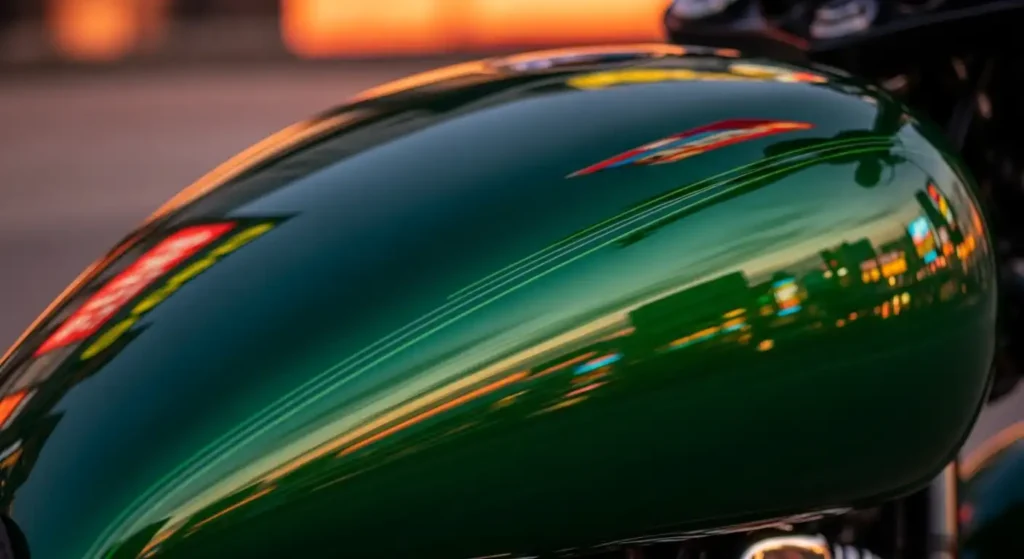
In the fast-evolving world of automotive aesthetics, 2026 has marked a definitive departure from the “matte-everything” era that dominated the early 2020s. We have entered the age of hyper-reflectivity. Dubbed the “Liquid Glass” revolution, this trend is redefining how enthusiasts view depth, clarity, and color saturation on everything from custom bobbers to high-performance SUVs.
For custom painters and airbrush artists, staying ahead of this curve isn’t just about using new products; it’s about mastering a sophisticated multi-stage workflow that creates an optical illusion of “wetness.” If you want your ride to look like it was dipped in molten jewels, Liquid Glass custom paint is the gold standard.
The Anatomy of a Liquid Glass Finish
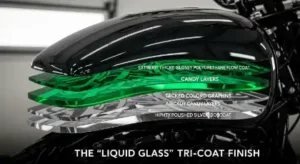 What exactly differentiates a “Liquid Glass” finish from a standard high-gloss clear coat? It boils down to refractive index and surface leveling. Unlike traditional two-stage paint (base and clear), the Liquid Glass look relies on a tri-coat or quad-coat system that utilizes translucent layers to trap and bend light.
The process generally follows this hierarchy:
- The Reflective Ground Coat: Usually a high-sparkle metallic or a polished “chrome” base.
- The Translucent Mid-Coat: Often a “Candy” or “Kandy” concentrate that provides the color without obscuring the metallic shimmer beneath.
- The Flow-Coat Layers: Multiple high-solids polyurethane clear coats, sanded and polished to a mirror-smooth finish.
The result is a finish where the color seems to “float” several millimeters above the actual metal, giving it that signature liquid appearance that is dominating the 2026 show circuits.
2026 Trending Colors: Beyond the Basics
While the technique is vital, the choice of pigment is what sets 2026 apart. This year, we are seeing a shift toward “Organic Metallics”—colors that mimic the natural world but with an artificial, hyper-bright intensity. We are seeing a surge in Deep Serpent Greens, Volcanic Obsidian, and Copper-Rose Golds.
These colors are particularly effective for those looking to highlight the complex curves of a motorcycle tank or the aggressive lines of a modern car. Interestingly, as we see more heritage tourism in regions like Butte County, many enthusiasts are choosing colors that reflect the natural landscapes of California—from the deep blues of the Feather River to the burnt oranges of a Pacific sunset—all rendered in a high-gloss Liquid Glass style.
The Technical Challenge: Why Prep is Paramount
You cannot hide mistakes under a Liquid Glass finish. In fact, the high-gloss nature of this trend acts like a magnifying glass for bodywork imperfections. If there is a single pinhole in the filler or a “DA mark” (orbital sander scratch) in the primer, the tri-coat will make it look like a crater.
Achieving this look requires precision block sanding. Professional painters are now spending 70% of their time in the primer stage, sanding up to 800-grit wet before the first drop of color ever hits the surface. This level of meticulousness is similar to the precision required in modern infrastructure projects. Just as safety regulations in California construction demand zero-tolerance for errors to prevent accidents, a show-quality paint job demands a flawless foundation to prevent visual failure.
Step-by-Step: The Liquid Glass Workflow
1. The Foundation
Start with a high-build epoxy primer. Once cured, block sand the surface using a guide coat to ensure there are no high or low spots. The goal is a surface so flat it could be used as a straight-edge.
2. The Metallic Base
For the “Liquid Glass” effect, the base coat needs to be highly reflective. 2026 has seen the rise of “Liquid Silver” bases that have a much smaller flake size than traditional metallics, creating a look closer to polished aluminum than glitter.
3. The Candy Mid-Coat
This is where the artistry happens. Apply 3 to 5 medium-wet coats of translucent color. Overlap each pass by 50-75% to avoid “tiger stripes” or mottling. The more layers you add, the deeper and darker the color becomes.
4. The Initial Clear and Leveling
Apply two full coats of a high-solids clear. Allow it to cure fully—often 24 to 48 hours—then wet sand the entire surface with 1000-grit sandpaper until the “orange peel” is completely gone and the surface is dull and flat.
5. The Flow Coat
This is the secret weapon. Clean the sanded surface meticulously and apply two more coats of clear. Because the surface is already flat, the clear will lay down like a sheet of glass. This is the “Liquid” in Liquid Glass.
Maintenance: Preserving the Mirror Shine
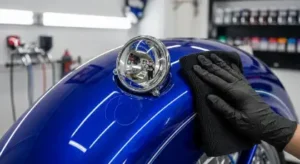 Once you’ve achieved the perfect finish, the challenge shifts to maintenance. A Liquid Glass finish is highly susceptible to “swirl marks” from improper washing. Owners are encouraged to use touchless washing methods and high-grade ceramic coatings.
For those who use their custom-painted vehicles for long-distance travel, such as a cross-country road trip, paint protection film (PPF) is often applied to high-impact areas like the front fairing or hood. This ensures that the 2026 “look” isn’t ruined by road debris or gravel.
The Role of Airbrushing in the Revolution
While the “Liquid Glass” trend emphasizes deep, solid colors, airbrushing hasn’t gone away—it has evolved. We are seeing “Ghost Graphics” become the preferred method for 2026. This involves airbrushing logos, pin-striping, or textures (like carbon fiber weaves) between the mid-coat and the flow-coat.
This technique buries the artwork deep within the paint. When the sun hits the tank, the graphics “pop” through the translucent layers, but in the shade, the vehicle looks like a deep, solid color. This subtle sophistication is what separates a professional custom job from a standard factory finish.
Conclusion: Is Liquid Glass Right for Your Project?
The “Liquid Glass” revolution isn’t just a passing fad; it’s a celebration of the painter’s craft. It requires patience, high-quality materials, and a workspace that is hospital-clean. However, the payoff is a vehicle that commands attention at any distance. Whether you are building a custom bike to cruise the scenic byways of the West Coast or preparing a show car for a national competition, this tri-coat technique is the ultimate way to showcase your style in 2026.
Ready to start your “Liquid Glass” journey? Explore our gallery of custom finishes and get inspired for your next project.